Thursday, January 5, 2012

Resolutions


“We will open the book. Its pages are blank. We are going to put words on them ourselves. The book is called Opportunity and its first chapter is New Year’s Day.” ~Edith Lovejoy Pierce
“Always bear in mind that your own resolution to succeed is more important than any other.” -Abraham Lincoln
“Character is the ability to carry out a good resolution long after the excitement of the moment has passed.” -Cavett Robert
“The Old Year has gone. Let the dead past bury its own dead. The New Year has taken possession of the clock of time. All hail the duties and possibilities of the coming twelve months!” ~Edward Payson Powell

Tuesday, October 25, 2011

Cancer Patients Benefit From Exercise

I am honored to post an article written by one of the followers of my blog. Reading it really hit home me. Many of you are unaware that I had a large benign tumor removed from my neck over this past summer.  Although it was not cancerous.  I had to complete 6 weeks of daily radiation, countless CT scan and MRI's, not to mention a difficult surgery that left me with an 8 inch scar. I can attest, as you will read below, to the benefits explained. Being the fitness nut that I am, I tried not let it get me down and neither should any one else.  Thanks again Liz for letting me post your article. 


There was a time when doctors were more likely to prescribe bed rest than exercise for adults facing a cancer diagnosis, but those days are gone. Many cancer researchers now believe patients can benefit from embracing exercise instead of avoiding it.

The evidence supporting an active lifestyle for cancer patients and survivors has been mounting in recent years with the release of several positive research studies and updated guidelines for cancer patients.
 

A British charity,
Macmillan Cancer Support, recently reviewed 60 studies and surveyed more than 400 health care workers about the value of exercise during cancer treatment. The group’s 2011 report, called “Move More,” said breast cancer patients could reduce their risk of recurrence or death from the disease by 40 percent if they maintained a recommended exercise level. The report said physical activity also could help bowel cancer patients to reduce their risk of death or recurrence by half and it could help prostate patients to reduce their risk of dying by 30 percent. 

Those are dramatic numbers when you consider that many patients traditionally have been instructed to reduce exercise after undergoing cancer treatment. In a statement about the recent report, Macmillan Chief Medical Officer Jane Maher noted, if physical exercise was a new drug, its benefits “would be hitting the headlines.”
 

Similar conclusions about the value of exercise to cancer patients were included in national guidelines developed by a panel of the
American College of Sports Medicine in 2010. The 13-member panel analyzed research studies about various cancers and found exercise could improve muscle strength, aerobic fitness, fatigue and life quality in prostate, breast and hematologic cancer patients. In the future they are planning to study the effects of exercise for other types of cancers like pancreatic cancer, lung cancer and rare types like peritoneal mesothelioma. So far there have only been positive results.

The panel suggested that cancer patients should aim for the same level of physical activity that is recommended for most of us – about 150 minutes of moderate aerobic exercise every week. However, the guidelines suggest that age, fitness, individual diagnosis and other factors should be considered when developing an exercise regimen. Some types of exercise might be more appropriate than others based on these factors, and some patients may feel too weak for physical activity at certain times.

The American Cancer Society also touts the benefits of physical activity for cancer patients who are able to exercise. Exercise can lessen fatigue, keep muscles strong, decrease nausea and lower the risk of broken bones, among other health benefits. However, the cancer society advises that it may be prudent for some patients to reduce physical activity if it causes pain, shortness of breath, a racing heartbeat or other health problems. 

Every cancer patient should consult his or her physician before adopting an exercise program. The cancer society has developed a list of safety tips and precautions for those who want to get the most from exercising. Go to this link for advice about starting out:
http://www.cancer.org/treatment/survivorshipduringandaftertreatment/stayingactive/physical-activity-and-the-cancer-patient.

Liz Davies is a recent college graduate and aspiring writer especially interested in health and wellness. She wants to make a difference in people’s lives because she sees how cancer has devastated so many people in this world. Liz also likes running, playing lacrosse, reading and playing with her dog, April. 

Saturday, August 20, 2011

Is Losing Weight Fast Dangerous?


Every once and a while I come across an article with some truth in it. Here is one that actually has some science behind it's claims.  

A reader emailed me the other day: “Is rapid weight loss dangerous?”
This is actually a fairly common question. And when I see it, here’s what I read between the lines: “How bad would it be if I starved myself to drop a few pounds?”
The answer: Pretty bad. Not because it’s unhealthy—though it can be—but because in the long run this strategy will make you fat. Really.
When it comes to losing weight, how fast is too fast? We asked Men’s HealthWeight Loss Coach Alan Aragon, M.S., a nutritionist who works with Olympic and professional athletes, for his perspective. His definition: “Dropping pounds so rapidly that in addition to losing fat, you lose muscle too. This isn’t ‘dangerous’ as in ‘life-threatening,’ but it’s not good for your overall health.”
Here's why: Losing muscle reduces your ability to burn calories and regulate your blood sugar, says Aragon—and, of course, it makes you weaker. (To keep your calorie-burn high, use our 100 greatest fitness tips of all time.) What’s more, lost muscle is often replaced by fat when you stop dieting. The result: You end up looking flabbier than ever. After all, each pound of fat takes up 18 percent more space on your body than each pound of muscle.
Aragon dug into the scientific research to determine the rate that different people could lose weight without losing muscle. His findings:
* Obese to morbidly obese: 3 to 5 pounds per week
* Overweight: 2 to 3 pounds per week
* Lean to average: 1 to 2 pounds per week
* Very Lean: 0.5 to 1 pound per week
Of course, you can help your cause even more by lifting weights while you diet. Research shows that this can prevent the wasting of muscle, helping ensure your weight loss is pure fat.
The other dangers of rapid weight loss: bone loss, dehydration, and an increased risk of binge eating in some people. “But these are typically the result of severe caloric restriction,” says Aragon. His solution: “I’ve found that you can use a simple formula to calculate a smart and effective caloric intake; it’s based on your targetbody weight.”
For example, let’s say you’re a man who weighs 220 pounds, but you’d like to tip the scales at 180 pounds. You’ll base your calorie intake on that of a 180-pound guy. Now if you don’t do any resistance exercise (you should!), simply multiply your target body by 11. That’s the minimum number of daily calories you should consume for healthy weight loss, with little risk to your muscles.
If you do lift weights, use 9—instead of 11—and add to that the number of hours you work out per week. So if you exercise one hour a week, you’ll multiply your target body weight by 10. If you exercise two hours a week, you’ll multiply your target body weight by 11; if you exercise three hours a week, you’ll multiply your target body weight by 12; and so on. (The extra activity will allow you to eat more and still lose just as fast.)
Then remember these tips as you start your weight loss program:
1. Prepare to plateau. “Your weight drop will be linear at first, meaning you’ll typically lose a steady amount every week,” says Aragon. “However, as you get lighter, your weight will tend to drop in a stepwise manner. So don’t get discouraged if scale holds for a few days, or even a couple of weeks. The closer you get to your goal, the longer the stalls or plateaus can be.”
2. Take a time out. Every 8 to 12 weeks, take 7 days completely off from dieting. “Don't consciously try to stuff your face, but don't rigidly restrict yourself either,” says Aragon. “This is a good mental and physical break from dieting that allows people to sustain their diets for longer periods.”
3. Redefine progress. “Look at other determinants of success besides the scale,” says Lisa Sasson, R.D., associate professor of nutrition at New York University. Monitor your triglycerides, blood pressure, and body fat percentage. As these numbers improve, you’ll have even more motivation to stick with your eating plan.
Remember the Men's Health mantra: If you have a problem, we have your solution.

Friday, March 18, 2011

Simple Motivation


In my experience, there is only one motivation, and that is desire. No reasons or principle contain it or stand against it.


-Jane Smiley

Saturday, February 19, 2011

Breaking The Pattern: How Motivation Plays A Role In Getting Healthy

ScienceDaily (June 30, 2008) — People fall into a pattern. They start out with the best intentions and do well for a little while … but then fall back into old habits. It’s a classic health trap: two steps forward, three steps back. People end up feeling bad about themselves. Moreover, the two-steps-forward-three-steps-back dance ends up increasing the health problems the behavioral changes were supposed to address in the first place.
Hands up if these scenarios are familiar:
  • You get the exercise bike/treadmill/elliptical you wanted for Christmas, but by April, the machine has been moved to the basement for lack of use.
  • You sign up for the weight loss plan that promises pounds will fly off your hips without you having to give up the foods you love. It works for awhile, until one day you discover you weigh more than you ever did.
  • You decide to give up smoking, but put it off until next week when you’re not so stressed.
Motivation expert Michael Vallis say most people fall into a pattern. They start out with the best intentions and do well for a little while … but then fall back into old habits. It’s a classic health trap: two steps forward, three steps back.
And that’s a problem. People end up feeling bad about themselves. Moreover, the two-steps-forward-three-steps-back dance ends up increasing the health problems the behavioral changes were supposed to address in the first place.
But people concerned about their health can not only start a new behavior but continue it if they’re honest and realistic about their motivation, says Dr. Vallis, health psychologist with Capital Health and professor of psychiatry and psychology at Dalhousie University. His main area of expertise is in adult health psychology, with an emphasis on diabetes, gastroenterology, cardiovascular risk and obesity.
“People really need to identify personal and meaningful motivations,” says Dr. Vallis, 53, a father of three children. “What’s going to keep you going when it gets hard?” (Some questions to ask yourself: Do you think your behaviour is a problem? How distressed are you about your behaviour? Are you interested in doing anything to change this behaviour? Are you ready to take action now?)
Next, the person has to change their behavior by laying out “smart, specific goals.” In other words, you can’t just resolve to “get more active,” you’ve got to identify when and for how long you’ll do an exercise, whether it’s yoga or swimming or cycling. “Get more active” turns into “I’m going to go for a brisk, hour-long walk on Thursday night at 6 p.m.”
The third part of making change stick is to recognize the role emotion plays in your health and coming up with strategies to cope without resorting to destructive behavior, for example, eating when you’re feeling down, or lighting up a cigarette when you’re in a social situation.
“Stress is what is going to knock people off the best-laid plans,” says Dr. Vallis. “All these unhealthy things—eating the whole carton of ice cream, drinking, smoking—are ways of medicating anxieties.
“If an unhealthy behavior serves a purpose for the patient, it’s important to ‘replace the function’ of that behavior. So, an emotional eater will often be unsuccessful at weight loss until they develop alternative methods of coping with their emotions other than eating.”
The Dartmouth, Nova Scotia native not only talks the talk, he runs. When his father died of cardiovascular disease at the age of 57, he realized he was at risk for heart disease, too. He started running when he was in graduate school and now “can’t not run—it’s part of my lifestyle.”
He says health professionals have to be good role models; it’s no longer acceptable for nurses or doctors to preach healthy living if they’re eating poutine in the hospital cafeteria or smoking on the sidewalk between patient appointments. He’s been doing training sessions with health professionals to get his message on motivation out to more people than he could reach one on one.

http://www.sciencedaily.com/releases/2008/06/080626150311.htm
http://www.flickr.com/photos/42931449@N07/5217748702/#/

Sunday, November 21, 2010

Surviving the Holidays Without Gaining a Pound


The opportunities to eat around the holidays seem endless, beginning on Halloween and not ending until New Year's Day. Toss in an out-of-control list of things to do – from parties to host and attend to gifts to wrap and ship – and it's no wonder most of us pack on the holiday pounds.
But this year can be different. Before the frenzy begins, establish a plan and detailed schedule for how you will manage all the things you need to do between now and New Year's Day. A few ideas to help ease the holiday stress:
  • Consider shopping online
  • Send out a holiday newsletter or photo card to everyone on your list
  • Scale back your social calendar to allow some down time to enjoy the spirit of the season
Even though it seems impossible to squeeze in more activities, your fitness routine is a priority. Physical activity of any kind, whether working out at the gym, doing a fitness tape at home, fast walking at the mall or going for a daily walk – helps you cope with stress while it burns calories and keeps muscles strong.

Don't Strive for Diet Perfection

Once you have your to-do list under control, the next task is figuring out how to enjoy the bounty of food without going on an eating frenzy. My strategy to get through the holidays without gaining a pound is to aim for "social weight maintenance." Forget about weight loss and focus on keeping the needle on the scale right where it is today. Don't expect to be perfect around the holidays. For the next six weeks, you need to allow yourself some flexibility so that you can enjoy your favorite holiday foods.
To maintain during the holidays, enjoy small portions of your holiday favorites but be careful not to go overboard. Follow the "80/20 rule": 80% of the time, you eat healthy foods and 20% of the time, you splurge a little on those once-a-year favorites. And 100% of the time, do at least 30 minutes a day of physical activity.

Best Bets on the Buffet

Making smart choices allows you to eat plenty of food and not feel deprived. To shave calories, go easy when adding nuts, cheese, cream sauces, gravy, butter, and whipped cream – additions that don't add much to the meal, but can add plenty to your waistline. Whenever you make holiday dishes, try to slash calories by using lighter, low fat or fat free ingredients. Experiment with new healthier recipes that may just become your new traditional favorites. Trim calories wherever you can so you leave the party feeling satisfied, but not stuffed.
Here are my picks for the best and worst holiday food choices:
Best BetsWorst Bets
Pretzels, low fat popcorn, baked chips with salsaCheese straws, fried snacks (potato chips)
Handful of plain nutsHandful or more of candy or candied nuts
Fresh fruits and vegetables with low-fat dressingFried veggies, wings, creamy or cheesy dips
Shrimp cocktail, clams, oysters, smoked salmonFried seafood
Low-fat cheeses on water crackers, low fat crackers or Melba toastHigh-fat cheeses and crackers
Vegetable or broth-based soupCream soups or bisques
Baked sweet potatoesSweet potato casserole
Cranberry relish or gelatin saladCranberry sauce
Mashed potatoes with a dab of gravy, or a plain baked potatoLots of gravy with your mashed potatoes or loaded baked potato
White-meat turkey without skinDark-meat turkey with skin
Lean meats without visible fatProcessed meats, sausages, fatty meats
Simply prepared veggiesVeggies in cream sauces, casseroles or topped with fried onions or cheese
Cornbread-, oyster- or fruit-based stuffingStuffi ng with sausage or high fat meats
Whole-wheat dinner rollsCroissants, butter rolls
Pumpkin pie with nonfat toppingPecan pie with whipped cream
Fruit sorbet, sherbet, or frozen yogurtCake or ice cream
Apple cider, mimosa, or bloody MaryEggnog
Chocolate-dipped strawberriesFruitcake or fudge

Focus on Fun, Family and Friends

Don't let food have the spotlight. Take the focus off food by getting family and friends involved in some fun activities during holiday parties. Go outside for a walk, sledding, ice skating, or building snowmen. Indoors, try a spirited game of charades, or rent an instructional dance video followed by a dance-off. Dancing goes hand in hand with the holidays so why not make dancing after eating a new holiday tradition for a great form of fun and recreation?

I Went Overboard!

The best-laid plans sometimes fail. If you over indulge, don't beat yourself up but make a pledge to be more in control next time. To compensate, eat a little less and exercise a little more the next day and learn from it so it won't happen again at the next holiday function.
Establish your own personal ground rules and do your best to stick to them, at least 80% of the time. Prioritize a little exercise every day; it will pay you back with renewed energy, stress control and even help you sleep. And remember to relax and enjoy, the holidays are supposed to be fun!
Holiday parties are much more than food and drinks. They are a time to delight in the traditions of the season, and enjoy the company of family and friends. If you keep the focus on the spirit of the season and heed the diet advice, you should get through the holidays without gaining a pound.

My Top 10 Personal Holiday Party Strategies

Over the years I have subscribed to a few basic rules whenever I go to a buffet or party:
  1. Always wear a snug-fitting outfit that does not easily expand so you have to hold in your stomach and use good posture.
  2. Carry a clutch bag that keeps one hand occupied.
  3. Eat a small but filling meal before leaving home such as a bowl of vegetable soup or a vegetable salad. This way you are not starving upon arrival and can take your time making a plan of what you will eat.
  4. If you don't love it, don't eat it. This is my golden rule at all times. I hate wasting food, but I hate extra pounds even more.
  5. No lingering around the buffet table, bar, appetizer or dessert areas. Socialize with your friends away from the food and drinks.
  6. Limit cocktails to two, with sparkling water and lime (which looks like a cocktail) enjoyed between drinks. Alcohol calories add up and if you limit it to two, you will feel better in the morning.
  7. Engage in mindful eating: make a single plate of food, sit down, and take your time to savor the tastes, flavors and enjoy every bite. This helps you recognize when you are full and reduces the likelihood of mindless eating the rest of the evening.
  8. Follow the 80/20 rule and indulge – but just a little and no second helpings.
  9. Anticipate those extra calories by eating light and exercising more on party days.
  10. You don't have to eat it all; sometimes all it takes is a few bites.

By Kathleen Zelman, MPH, RD, LD


Tuesday, November 9, 2010

Holiday SPECIAL!!!!!!! Friends and Family Pricing


Did you know the average American gains 10-15lbs over the Holiday season each year?

Until the end of the year I will be offering my service's at a huge discount. For EVERYONE, I will give a Free Evaluation, as well as a 30% discount off all sessions. If that not enough, I will be offering 20% off all Top Form Supplements as well.

Now is the time to lose the FAT and look great for the new year. Let me teach you how you can lose the FAT not just the weight and still enjoy the holidays. So hurry and take advantage of this while it lasts, because when the new year roles around and so do you, things wont be so easy.

Please email or call to get scheduled.

 jared@resolutewellness.com or (801)792-5491

http://www.flickr.com/photos/lara604/4171437377/

Sunday, October 31, 2010

FREE Fat Loss Holiday Webinar!!!


Want to avoid gaining any extra weight over the holiday season? I will be teaching another Fat Loss WEBinar this coming Wednesday (Nov 3rd) at 6:00pm MDT. This WEBinar is free to attend. I will be talking about the 5 components of fitness that will start you on your way to ultimate health.

To attend the WEBinar, here is what you need to do…

1. Please join my meeting, Wednesday, November 3 at 6:00 PM Mountain Daylight Time.
https://www1.gotomeeting.com/join/240805072

2. Use your microphone and speakers (VoIP) - a headset is recommended. Or, call in using your telephone.

Dial 415-363-0070
Access Code: 240-805-072
Audio PIN: Shown after joining the meeting

Meeting ID: 240-805-072

GoToMeeting®
Online Meetings Made Easy™

Tuesday, October 5, 2010

Motivation

“Don’t wait until everything is just right. It will never be perfect. There will always be challenges, obstacles and less than perfect conditions. So what. Get started now. With each step you take, you will grow stronger and stronger, more and more skilled, more and more self-confident and more and more successful.”
~Mark Victor Hansen

-thanks Jan

Saturday, September 4, 2010

Corporate Wellness

The rising cost of health care and it’s affect on the bottom line of corporations across America is a major concern for today’s leaders. Long outdated is the model of focusing treatment and resources on those who are already sick or disabled. We are now facing trends of shrinking margins, the recent health care bill and a lack of productivity due to absenteeism and the rising cost of treatment.

An increasing number of corporations are taking a proactive approach to increasing costs by providing wellness programs as a part of their employee benefit package. Research shows that corporations who provide healthy choices and provide employee wellness programs are seeing long term savings in terms of sick time disability and other health care costs. Companies that have adopted, and implemented an effective wellness culture are seeing a happier, more productive workplace.
There are numerous approaches and components available to employers with measurable outcomes. Each program must be individualized for your organization, and all options must be carefully analyzed to find a best fit for specific and long term goals and objectives. An article entitled One Wellness Program Doesn’t Fit All Businesses, found that the key to a successful wellness program is developing a customized program that meets the individual goals and needs of each individual organization.

In the following few pages we will examine the problems of rising health care more closely, look at the research, and propose a solution that will benefit both the organization as well as the employee.

The Problem

Today employers are finding themselves staring at a major fork in the road. With the cost of Health Care increasing at a rate of 15% annually, company profitability and long term survival are in jeopardy. Studies have indicated that the rapidly increasing cost of health benefits is the single largest expense line on a company’s profit and loss statement. These increases are becoming harder to sustain at any level.

Only one in twenty adults regularly engage in the top three healthy lifestyle behaviors.
* Well Balanced Nutrition* Get at least 7 hours of sleep
* Regular Exercise
0ver 67% of the American population is now considered overweight or obese. This means that there are close to 100 million Americans that are obese! Studies are also predicting that by 2012 the percentages will reach 75%. Regardless of age, gender, or race the number of overweight and obese Americans is increasing faster than they are decreasing. Since 1980 the prevalence of overweight people has increased from nearly 15% to 34%+. During the same time span obesity has skyrocketed from 15% to over 67%. From 1988 to 2002 the prevalence of extreme obesity has increased from 3% to 5%.

Research has shown that as weight increases to reach the levels referred to as "overweight" and "obese," the risks for the following conditions also increases:• Coronary heart disease
• Type 2 diabetes
• Cancers (endometrial, breast, and colon)
• High blood cholesterol
• Hypertension (high blood pressure)• Dyslipidemia (for example, high total cholesterol or high levels of triglycerides)
• Stroke
• Liver and Gallbladder disease
• Sleep apnea and respiratory problems
• Osteoarthritis (a degeneration of cartilage and its underlying bone within a joint)
• Arthritis
• Gynecological problems (abnormal menses, infertility)
Higher grades of obesity are associated with excess mortality, primarily from cardiovascular disease, diabetes, and certain cancers. Wellness programs that improve social and physical environments for healthful eating and physical activity are great preventive strategies for a healthy environment. This equates to healthier, more productive employees as well as a healthy bottom line.

The Research, Statistics and Costs
When researching the benefits of a wellness program it’s good to investigate some of the data.
Consider the following:
* According to the Center for Disease Control (CDC), the typical American diet is responsible for most of the preventable diseases, including 90% of diabetes, 80% of heart disease, and 70% of colon cancer.
* The CDC also reports that less than 16% of adults engage in regular physical activity, while over 60% report getting virtually no regular exercise.

* According to the Wall Street Journal the 15 most expensive diseases account for 43% to 61% of health care spending growth from 1987 to 2000. The four costliest conditions are heart disease, mental disorder, pulmonary disorders, and cancer account for most of the increase.

* The American Journal of Preventative Medicine found that, employers who invest in worksite health promotion programs can see a return of $2-$10 for every dollar invested over a 2-5 year period. Documented savings are a combination of lower medical costs, absenteeism, worker’s comp claims, short-term disability and presenteeism.

* A review of 32 studies of corporate wellness programs found claims costs were reduced by 27.8%, physician visits declined 16.5%, hospital admissions declined 62.5%, disability costs declined 34.4%, and incidence of injury declined 24.8% after a corporate wellness program was instituted.

* Johnson & Johnson reported average annual savings of $8.5 million during 4 years when 18,331 employees participated in a health and wellness program at work.

* A separate study of the same group showed reductions in tobacco use, sedentary lifestyle, high blood pressure, high cholesterol, low dietary fiber intake and poor motor vehicle safety practices.

* Studies show that employees who utilized an employee fitness center gained both physical and psychological benefits: 64% reported an improvement in morale, 70% reported improved job satisfaction, 66% reported improved work productivity, 83% reported improved energy levels, 76% reported an improvement in stress management, and 70% reported an increase in attentiveness at work.

* Employers currently spend more than $390 billion per year on employee health insurance, with annual health care cost increases significantly exceeding the overall rate of inflation.

* The Wall Street Journal, states health care costs per capita will reach $7,500 this year (2008), more than double the $3,470 per person in 1993.
* The rate of inflation in this arena continues to grow at an unsustainable annual rate of 8-14%.
* National data has shown that employee turnover ranges between 20-25% for firms of 1,000 or more employees.

* The actual dollar cost of turnover varies based on a variety of factors, but estimates range from $25,000 per individual and a range of 75% to 150% of an employee’s annual salary.

* In a study of 370,000 employees, Goetzel et al found that presenteeism losses accounted for the majority of per person annual total costs for 9 out of the top 10 most expensive health conditions, with only heart disease having the majority of total costs attributed to medical claims. Other notable factors include:
* Unapproved absenteeism
* Lack of productivity
* Increased turnover
* Recruitment
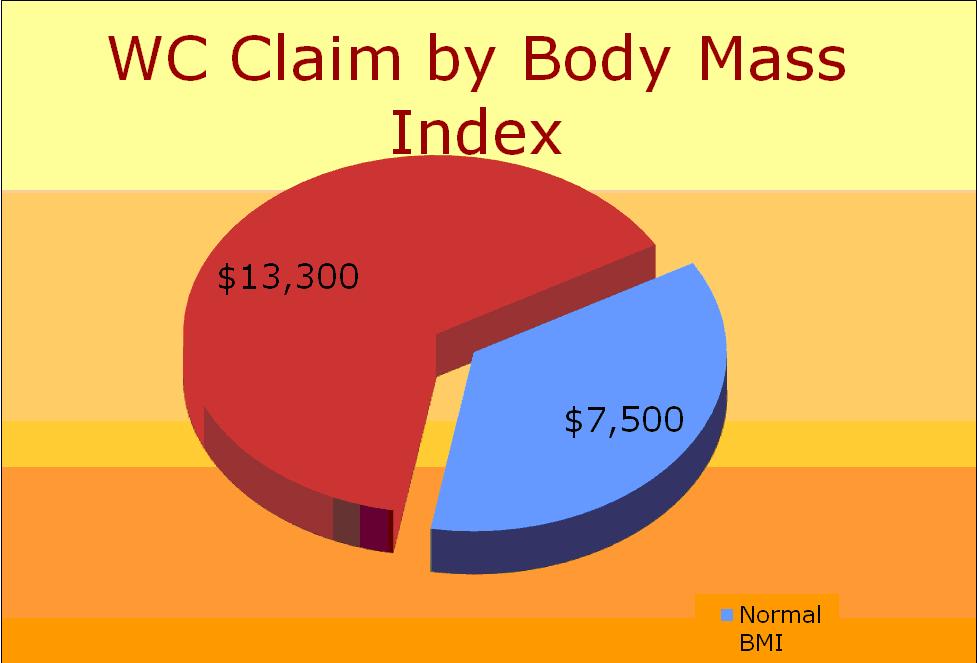
* Decrease in customer service* A Duke University study involving 11,700 individuals, tracked the increased costs tied to BMI (Body Mass Index).
* Normal BMI $7,500
* Overweight $13,300* Mildly Obese $19,000
* Moderately Obese $23,000
* Severely Obese $51,000

* It must be noted that this “overweight” category (excluding all obese levels), represent well over 30% of the entire population, comprising an immense cost to employers.

The Graphs above clearly show that its not just the obese and moderately obese that need attention.

* Research has also shown that lack of exercise is a major contributor to serious health conditions including but not limited to osteoporosis, stroke, and mental health conditions.

* Reduction in health care costs by 20-55%

* Decrease in short-term sick leave by as much as 32% (Ceridian Prop ROI Tool, 2003)

* A savings of between $3 and $6 for every $1 invested in wellness (U.S. CDC)

* Drop in work comp and disability by as much as 30%

* Enhanced recruitment and retention for all positions

* Examples of companies that have pursued a model of wellness are expansive and growing quickly. 11% of companies have full-fledged wellness programs as part of their employee benefits, and an additional 8% plan to add wellness in the next 12 months.

* Successful programs include Bank of America, Pacific Bell, Coca Cola, Prudential, DuPont, and Johnson & Johnson.

This data can seem overwhelming; however, it should also bring solace to corporations who currently have, or are now considering implementing a comprehensive wellness program. The bottom line will reflect efforts across all ranges of employees regardless of the individual’s Body Mass Index. Body Mass Index (BMI) is a number calculated from a person's weight and height. BMI provides a reliable indicator of body fatness for most people and is used to screen for weight categories that may lead to health problems.


The Solution

When considering a corporate wellness program, keep in mind that it is far better, and less expensive, to prevent employee health problems than to treat them after they occur. It is evident that past attempts to control health related costs have failed and stand to drastically increase in the next few years. Because of the threat of increased expenses, employers sink time and money in a one size fits all programs. A comprehensive wellness program needs to be tailored to fit each individual employee regardless of health issues, BMI, goals and limitations.

Keep the following in mind when selecting an addition to your wellness program:
* Is this customizable to the needs of the few or the majority of your employees, and does it meet their individual needs and goals?
* Fat loss
* Firming and toning
* Muscle gain
* Diabetes
* Cholesterol reduction
* Thyroid issues
* PCOS
* Varieties of nutrition sensitivities
* Event specific training and nutrition
* Professional consultation
* And the list goes on…
* Who can use the services provided?
* Are results measurable and attainable?
* Can you at any time get objective data?
* What is provided by the organization?
* Customized programs based on employees needs, wants and goals
* Nutrition
* Cardio
* Resistance training
* Supplementation
* Professional assistance on a weekly basis and as needed
* How time consuming is the process for you and your team?
* What are the costs?
* Corporate
* Employees
* Efficiency of programs and services
* Track record and history
* Ongoing educational seminars
* Wellness newsletters

Keeping the above considerations in mind, your wellness team will be able to identify the organization that will best suit your needs and goals in designing, or adjusting, your wellness program.

Conclusion

While the information that exists regarding wellness programs is overwhelming and difficult to sift through; the statistics speak for themselves. Employers who do not consider a high quality wellness program face an increase of 10-15% in direct costs related to rising health plan premiums; not to mention all of the indirect costs related to an unhealthy workforce. Numerous corporations have implemented successful wellness programs and have seen dramatic results in the increased health and productivity of their employees, as well as reduced costs associated with absenteeism and health care.


We provide the finest quality personalized nutrition and fitness programs. We offer individualized programs tailored to the specific needs of our clients. Your employees will receive the finest programs and world class service by our staff. We use sound scientific guidelines to meet the needs of our clients.

We offer individualized:
o Wellness seminars
o Body fat analysis
o Fitness assessments
o Nutrition, cardio, weight training and supplementation programs
o Individualized accountability
o Progress tracking
o Do it yourself programs
o Online consultations
o Phone consultations
o One on One consultations
o Goal setting
o Encouragement and motivation

We focus on improving not only the health of your employees but helping them change their lifestyles.

We offer affordable options regardless of budget or needs. You owe it to your workforce, as well as to your bottom line, to take a closer look. You won’t be disappointed!

To schedule a meeting please call or email Jared  801-792-5491 jared@resolutewellness.com